The Hispanic community in the United States surpasses 60 million people and continues to grow every year. Opening a Latino products store in the United States is a real opportunity today for entrepreneurs who know their community and understand what products they’re looking for. But between the idea and your first customer, there are decisions that need to be made in order: where to locate your store, what permits to complete, what assortment to offer from day one, and how to organize it all without depending on five different distributors.
In this guide, you’ll discover where to start, what requirements you need to meet, how to choose the best location, and most importantly, how to build an assortment that keeps your customers coming back again and again.
Why is now a good time to open a Latino products store in the United States?
The Hispanic community in the United States already surpasses 60 million people and continues to grow every year. In southeastern states like North Carolina, Georgia or Tennessee that growth is visible on the streets: more Latino restaurants, more bakeries, more services in Spanish. Each of those businesses is a visible sign of a community that already lives there and is looking for a place to buy their own products.
The numbers confirm what you see in the neighborhood:
- The Latino-owned businesses grew 69% since 2012, well above the national average.
- They generate nearly 900 billion dollars in annual sales..
- The Latino entrepreneur is the fastest-growing group starting businesses in the country.
For anyone thinking about opening a store, this means two things: the demand exists and is well documented, and the community is already settled and waiting for a business that speaks their cultural language.
You’re not inventing a market — you’re entering one that already works and needs more businesses that understand it.
Where to open your Latino Products Store
Choosing a good location goes far beyond the price of rent. The most important thing is to set up in an area with an established Latino community and consistent demand for Hispanic products.
According to the most recent data from the U.S. Census Bureaustates like North Carolina and Georgia. Además, estados como South Carolina and Tennessee stand out for the steady growth of their communities, making them markets with strong potential for new businesses.
Before making a decision, consider factors like:
- The size and growth of the Latino community in the area.
- Existing competition— what other stores carry and where opportunities to differentiate exist.
- The accessibility of the space,including visibility, parking, and ease of access for customers.
- The commercial surroundings— whether there are nearby businesses that attract the same audience, such as Latin butcher shops, bakeries, or restaurants.
Choosing a good location isn’t just about finding an available space — it’s about setting up your business where people are already looking for the products you want to offer.
What Do You Need to Legally Open Your Store in the United States?
The paperwork to open a business in the United States is simpler than most entrepreneurs thinkYou don't need citizenship or permanent residency to register a business, and much of the process can be done in Spanish with free guidance.
The basic steps to set up your store:
- Register an LLC (Limited Liability Company): it protects your personal assets and gives you a legal structure to operate. It is filed in the state where you plan to open.
- Get your EIN (Employer Identification Number): it's free, filed online with the IRS, and it's the number you'll use to open your business bank account and manage taxes.
- Business license and local permits: each state and city has its own. If you'll be handling food, you'll need additional health permits.
- Business bank account: keep your business finances separate from your personal finances from day one.
If you don't have an SSN, you can move forward with an ITIN number to register the LLC and get your EIN. The full process takes between 2 and 6 weeks depending on the state.
Organizations like SCORE and the SBA offer free mentorship in Spanish and the SBA offer free mentorship in Spanish for entrepreneurs taking this step for the first time.
What products should your store carry from say one?
Depende de una cosa: the Latino community you’ll be serving.In an area with a mostly Mexican population, the products that sell aren’t the same as in an area with a Colombian, Honduran, or Salvadoran community. Each community has its own brands, shopping habits, and products they ask for by name.
There’s also the option of opening a general Latino store that serves multiple communities at the same time. In areas with a mixed Hispanic population, this model works well because the product mix covers multiple origins and customers find what they need regardless of their home country.
In either case, a Latino products store doesn’t sustain itself on food and groceries alone. The highest-turnover and best-margin categories are:
- Health and wellness: over-the-counter medicines, syrups, pain relievers, vitamins, hydration serums.
- Personal care: shampoo, soaps, toothpaste, deodorants, creams.
- Household cleaning: detergents, fabric softeners, bleach, toilet paper, brooms, mops, candles.
These are weekly-use products that Latino customers prefer to buy in the brands they’ve known since their home country. A Mexican customer looks for their brands by name. A Colombian looks for theirs. The same goes for Honduran and Salvadoran customers. It’s not a whim — it’s brand loyalty since childhood, and understanding what Latino consumers look for when shopping at a Hispanic store helps you decide which products your store can’t go without.
Step by Step to open your Latino Products store in the United States
You now have the full picture. Now turn everything above into action with these concrete steps:
- Define which community you’ll serve. Identify the predominant Latino origins in your area and decide whether your store will specialize or operate as a general Latino store.
- Walk your neighborhood and study the competition. Count how many Latino stores are nearby, what they sell, and what the area is missing.
- Register your LLC and get your EIN. If you need free guidance in Spanish, reach out to SCORE or the SBA in your city.
- Secure your location. Apply the location criteria: Latino population density, accessibility, and a rent your starting capital can cover for the first six months.
- Contact a wholesale distributor with a catalog organized by country of origin. Request the full catalog, define your initial product mix based on your community, and set a restocking schedule from the very first week.
The order matters. Defining your community and your product mix before signing a lease saves you from the most costly mistakes of the first year.
Already know what you need? Find a Latino Products Distributor with a catalog by country of origin
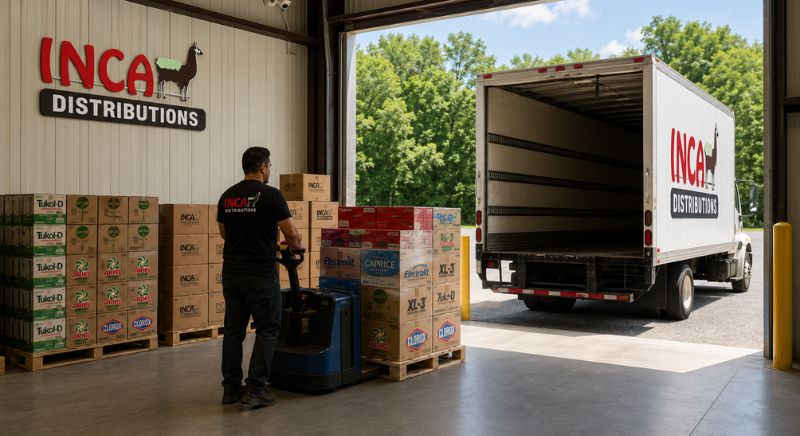
If your store will be in the southeastern United States, Inca Distributions is the wholesale distributor of Hispanic products that can help you start with the right product mix from your very first order.
What we offer:
- Catalog of over 2,300 products organized by country of origin: Mexico, Colombia, Honduras, and El Salvador.
- Three complete product lines: health and wellness, personal care, and household cleaning.
- Direct delivery in North Carolina, South Carolina, Georgia, Virginia, and Tennessee.
- One order, one supplier: your store’s entire non-food product mix fulfilled in a single delivery.
One order. One Latino products supplier. The brands your customers already ask for by name. Start stocking your store with the backing of nearly 20 years supplying Latino businesses in the Southeast.
Need a product supplier for your Hispanic store?
At Inca Distributions we put the best brands in personal care, cleaning and household supplies, and health and wellness within your reach.
Frequently Asked Questions about opening a Latino products store
How much startup capital do you need to open a Latino products store in the United States?
There’s no single figure because it depends on the state, the size of the space, and the initial inventory. As a general reference, a small store can get started with an initial investment of between $15,000 and $40,000 USD covering rent, deposit, store setup, and the first wholesale order. Working with a distributor that allows consolidated orders helps you control that investment from the very first month.
Can you open a Latino products store without an SSN or as an undocumented immigrant?
Yes. In the United States you can register an LLC and get an EIN using an ITIN number, without needing a Social Security Number or permanent residency. Organizations like SCORE and the SBA offer free guidance in Spanish for entrepreneurs in this situation.
How long does it take to complete all the paperwork to open?
The basic legal process (LLC, EIN, bank account, and local licenses) takes between 2 and 6 weeks depending on the state. The most time-consuming part is usually finding and setting up the location. Many entrepreneurs move forward with the legal paperwork while searching for a location so they don’t lose time.
Do you need to speak English to run a Latino store in the United States?
It’s not essential for the day-to-day business, since most of your customers will be Spanish-speaking. However, a basic level of English makes it easier to handle county paperwork, communicate with service providers, and manage banking. Legal steps like registering the LLC and getting the EIN can be done entirely in Spanish with the right support.
Which product categories offer the best margins in a Hispanic store?
The highest-turnover and best-margin categories tend to be health and wellness (OTC medicines, syrups, vitamins), personal care (shampoo, soaps, toothpaste), and household cleaning (detergents, fabric softeners, bleach). These are weekly-use products that Latino customers prefer to buy in brands from their home country, which drives consistent repeat purchases.
How to find a reliable wholesale distributor of Hispanic products?
Look for a distributor that carries a catalog organized by country of origin, offers direct delivery in your state, and lets you place a single consolidated order instead of coordinating with multiple suppliers. Check their track record, ask other Hispanic store owners in your area, and request the full catalog before committing to your first order.
What is the most efficient wholesale distribution model for a new Latino store in the southeastern United States?
The most efficient model for a new store is working with a wholesale distributor that consolidates health, personal care, and household cleaning products from different countries of origin (Mexico, Colombia, Honduras, El Salvador) into a single order with direct delivery. This reduces logistics costs, simplifies restocking, and lets the owner focus on serving their community instead of coordinating multiple suppliers.